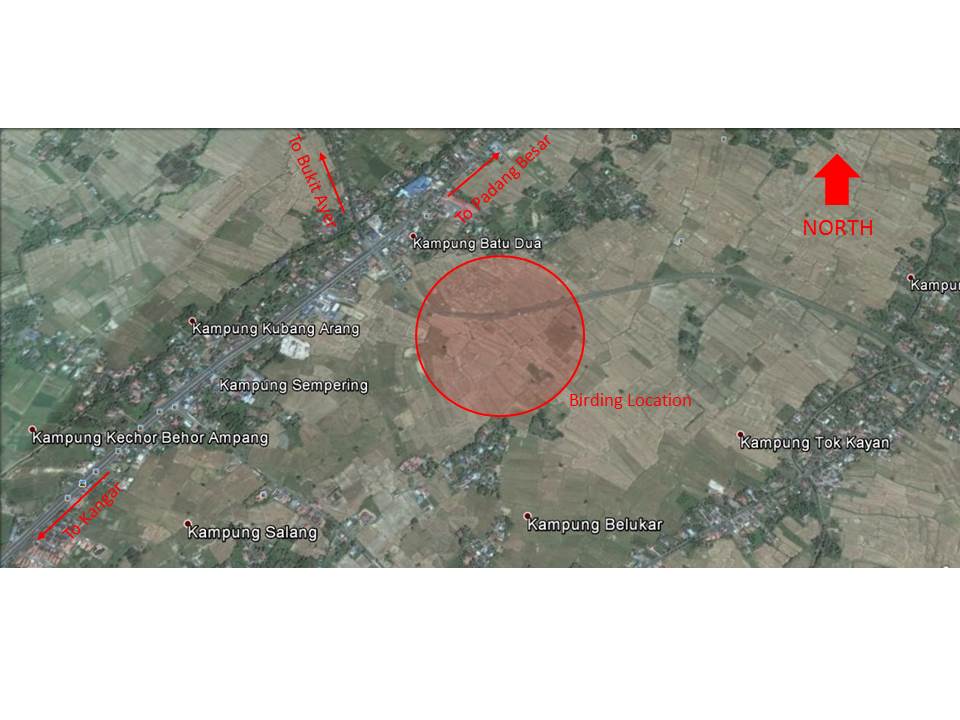
I have not been to the sugarcane plantation area in Chuping for quite sometime now. The last time i went there was a few years ago when i managed to photograph a couple of Changeable Hawks nesting on a small hill by the roadside.


However, the scene has changed now, the sugarcane plant is gone. It is just acres and acres of grassland as far as your eyes can see. It looks like a praire or a scene in Nebraska. Maybe the owner does not know what to do with the land right now. To plant sugarcane or to plant rubber trees, or to plant more profitable species??


I almost forgot how to get there as it has been quite a while, there also some new roads leading to the area. Coming from Tasik Melati direction toward Taman Angsana, and straight until i saw a factory that processes sugar into alcohol, turned left at the junction toward RPA Chuping, a few kampungs and eventually led me to the road that runs along the plantation toward Padang Besar. Along the way you will pass a PPP(anti-smuggling unit) checkpoint which confirms that you are on the right direction. A guard took a look at my daughter Tasha and me, saw our big camera and long lens, smiled and let us pass.

Please bear in mind that Chuping is a huge area, you could easily find some productive spots along the way to the sugarcane plantation estate. You propably need a few days to really explore the place, i only had two hours. So my main search area was along the main road in front of the plantation leading to Padang Besar - it is called drive and search with camera ready.

It was drizzling on the way there, so we drove slowly while scanning the side of the road for any birds. We pulled over the hill where i saw the Changeable Hawks on the previous trip, but saw nothing, no birds, no nests, maybe they have moved. As a matter of fact we did not see much along the road except a big Purple Heron flying overhead. We made a U-turn but it was gone. I could not figure out the lack of birds in such a huge open area. Could it be because the disappearing of the sugarcane plant? With the plant gone other lifers like big insects, rodents etc will go too. That means less food for certain birds, owls, hawks, kites etc. Certain birds require some hideouts, trees to protect them from raptors, with just grassland they will feel exposed and will move to other areas. Owls and raptors love open grassland because they can scan for rodents and snakes with their sharp eyes and acute hearing for hundreds of meters from their perching points.
We did see something moving in the air and hovering like waiting to pounce on something on the ground. It turned out to be a Black-winged Kite hovering at a height of eight to ten storeys over the field trying to snatch its prey. I pulled over immediately, grab my camera and took a few burst shots before it flew away. It was an awesome sight because i had never seen other raptors that could hover like that before. Below are a series of shots showing the kite hovering to strike its prey:
 | |
| circling in the air to look for preys |
 | |
| spotted a prey and zooming in |
 |
| hovering over its prey |


 |
| beautiful...like a ballet |
After that the sky started to turn dark which was a cue for us to split, end the session and come back some other day maybe spending more than two hours.


The area is so huge, and if i had spent more time and explored the inside of the plantation (if they permit me) i am sure i would find more species. Looks like i have to return to this place soon.

The area is so huge, and if i had spent more time and explored the inside of the plantation (if they permit me) i am sure i would find more species. Looks like i have to return to this place soon.
Thanks for reading and happy birding.